Learn to Master These 4 Bodyweight Exercises
strength training doesn’t always require costly gym memberships or heavy equipment. In fact, some of the most effective exercises for building muscle and enhancing overall fitness rely on nothing more than your own body weight.
Whether you’re just beginning your fitness journey or returning after a long break, mastering a few basic movements can help you build a strong foundation for future progress. These exercises enhance strength, coordination, balance, mobility, and muscle endurance while preparing your body for more advanced workouts later.
According to celebrity fitness trainer Ngo Okafor, learning proper technique before adding hindrance is one of the smartest ways to prevent injuries and achieve better long-term results. Once you’ve mastered the basics, you can gradually enhance the difficulty by adding weights, increasing repetitions, or trying more advanced exercise variations.
Another benefit of bodyweight exercises is their convenience. You can perform them almost anywhere—at home, in a park, while traveling, or even during a lunch break. Since no equipment is required, it’s much easier to stay consistent with your workouts.
Besides building muscle, these exercises also improve posture, strengthen your core, enhance joint stability, and facilitate daily movements such as lifting objects, climbing stairs, or getting up from a chair with ease.
If you’re looking for a simple but highly effective home workout, these four bodyweight exercises deserve a permanent place in your routine.
Why Bodyweight Exercises Are Great for Beginners
Many people believe they need heavy weights to build muscle. While training with weights certainly has advantages, bodyweight exercises are often the best place to start.
They allow you to:
Learn proper movement patterns.
Improve flexibility and mobility
Build muscular endurance.
Strengthen stabilizing muscles
Reduce injury risk
Enhance overall body awareness
Why Mastering the Basics Matters
Many beginners make the mistake of jumping straight into advanced workouts they see on social media. While those exercises may look impressive, they often require a level of strength, mobility, and coordination that takes time to develop.
Mastering fundamental bodyweight movements allows your muscles, joints, and nervous system to work together more efficiently. Practicing these exercises consistently can improve your balance, posture, flexibility, and overall mobility. Once you’ve mastered these foundational movements, you’ll be better prepared to progress to more advanced strength-training exercises. to heavier weights or more advanced exercises becomes much easier and safer.
Another major advantage of bodyweight training is that it teaches you how to control your own body before adding external resistance. This control is necessary for performing compound exercises like deadlifts, bench presses, lunges, and overhead presses correctly later on.
Consistency is also much easier with bodyweight workouts because they don’t require a gym membership or expensive equipment. Whether you’re at home, traveling, or short on time, you can complete an effective full-body workout almost anywhere. Even spending 20 to 30 minutes a few times each week can lead to noticeable improvements in strength, endurance, and muscle tone.
Remember that building muscle isn’t about completing hundreds of repetitions as quickly as possible. Quality matters far more than quantity. Performing each movement slowly, maintaining proper form, and focusing on muscle engagement will produce much better results than rushing through your workout.
As your fitness enhances, these same exercises can continue challenging your body simply by increasing repetitions, slowing the tempo, adding pauses, or incorporating light hindrance. That’s why experienced trainers continue to include these foundational movements in their own workout routines—even after years of strength training.
Once your technique improves, transitioning to dumbbells, kettlebells, or barbells becomes much safer and more effective.
1. Squats
Sets: 3
Reps: 10
Muscles Worked
Quadriceps
Glutes
Hamstrings
Core
Calves
Squats are widely considered one of the best lower-body exercises because they closely mimic daily movements like sitting down and standing up.
Regular squats help strengthen your legs while enhancing balance, flexibility, and mobility. They also activate your core during the movement, making them a fantastic full-body exercise.
How to Perform a Squat
Stand with your feet about shoulder-width apart.
Keep your chest upright while tightening your core muscles throughout the movement.
Push your hips backward as if sitting in a chair.
Lower yourself until your thighs are nearly parallel to the ground, or as low as your mobility comfortably allows.
Press through your heels to return to the starting position.
Move slowly and maintain control throughout each repetition instead of rushing through the movement.
2. Straight-Arm Crunch
Sets: 3
Reps: 10
Muscles Worked
Upper abdominal muscles
Deep core muscles
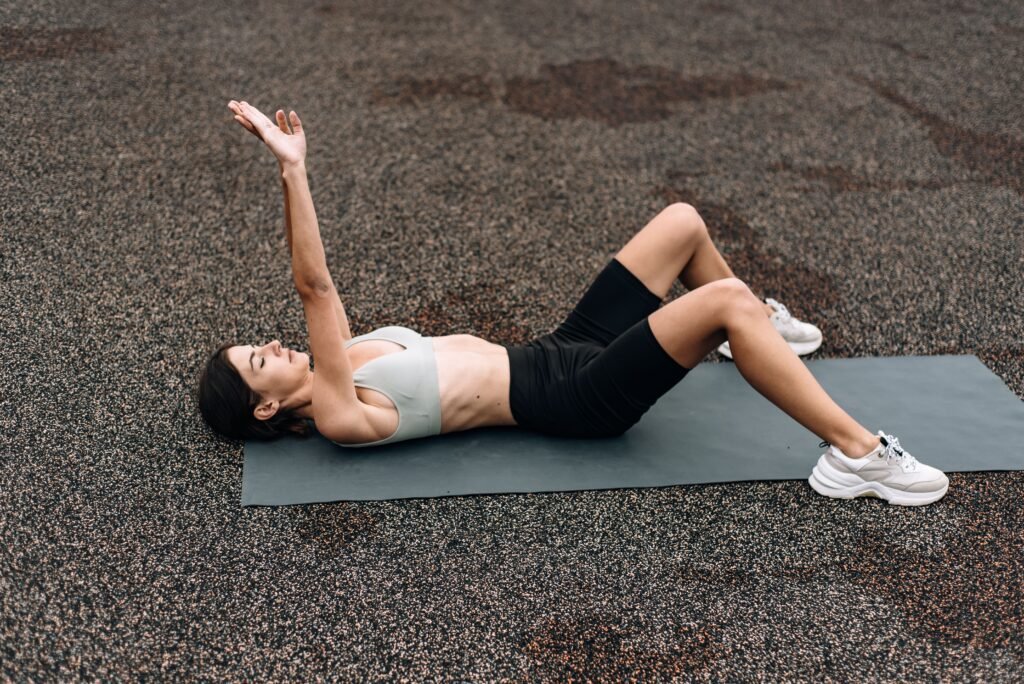
A strong core supports nearly every movement your body performs. The straight-arm crunch is an excellent beginner exercise because it teaches proper abdominal engagement while enhancing spinal stability.
Unlike traditional crunches that rely on momentum, this variation encourages better muscle control.
How to Perform a Straight-Arm Crunch
Lie on your back.
Bend both knees and place your feet firmly on the floor in a comfortable position.
Extend both arms overhead.
Tighten your abdominal muscles.
Slowly lift your shoulders toward the ceiling while reaching upward.
Lower yourself back down with control.
Avoid pulling your neck forward. Instead, let your abdominal muscles do the work.
3. Leg Raises
Sets: 3
Reps: 10
Muscles Worked
Lower abdominal muscles
Hip flexors
Core stabilizers
Leg raises are excellent for strengthening the lower portion of your core while enhancing stability in your entire midsection.
Although they appear simple, performing them correctly requires good control and proper technique.
How to Perform Leg Raises
Lie flat on your back with both legs extended.
Place your hands beside your body or underneath your hips to facilitate.
Tighten your core.
Slowly raise both legs together.
Lift until your legs are nearly vertical.
Lower them slowly without allowing your lower back to arch.
The slower you perform each repetition, the more effective the exercise becomes.
4. Push-Ups
Sets: 3
Reps: 10
Muscles Worked
Chest
Shoulders
Triceps
Core
Push-ups are one of the most effective bodyweight exercises for developing upper-body strength and overall stability.
Besides strengthening your chest, shoulders, and arms, they also require your core to stabilize your entire body while the movement.
How to Perform Push-Ups
Begin in a high plank position.
Place your hands slightly wider than shoulder-width apart.
Maintain a straight line from your head down to your heels throughout the exercise.
Tighten your core.
Slowly bend your elbows and lower your body until your chest comes close to the floor.
Push yourself back up until your arms are fully extended.
If regular push-ups feel too difficult, start with knee push-ups or incline push-ups against a sturdy bench or wall.
How to Make These Exercises More Challenging
As your strength improves, your body gradually adapts to the same routine. To continue building muscle and improving fitness, you’ll need to enhance the difficulty over time.
Simple ways to progress include:
Enhance repetitions
Add another set
Slow down each movement.
Hold the most difficult position for a few seconds.
Wear a weighted vest.
Hold dumbbells during squats.
Use ankle weights for leg raises.
Try advanced push-up variations.
Progressive overload is one of the most effective ways to continue gaining strength and muscle.
Sample Beginner Bodyweight Workout
Perform the following routine two to three times each week:
Squats — 3 sets × 10 reps
Straight-Arm Crunches — 3 sets × 10 reps
Perform 3 sets of 10 controlled leg raises.
Push-Ups — 3 sets × 10 reps
Rest for about 45–60 seconds between sets and focus on maintaining proper form during each exercise.
As you become stronger, you can gradually increase the number of repetitions or add hindrance.
Conclusion
Building strength doesn’t have to start with costly gym equipment or advanced workout programs. Mastering simple bodyweight exercises like squats, straight-arm crunches, leg raises, and push-ups can improve muscle strength, core stability, mobility, and overall fitness from the comfort of your home.
The key to long-term success is steadiness. Focus on learning proper technique first, gradually increase the challenge as your body adapts, and stay committed to your routine. Over time, these four foundational exercises can help you build a stronger and healthier body.